When Both of Your Baby Daddies Get Along
I have two dissimilar children, with two different fathers, neither of whom we live with and to both of whom nosotros are shut. I am non the typical single mother, but and then at that place is no typical single mother whatsoever more there is a typical mother. In fact, it'due south our unbridled fantasies and crude stereotypes of this "typical single mother" (overweight, brusque-tempered, popping out babies and so that she can snare a council apartment) that get in the way of our truly apprehending the richness and variety of thriving families.
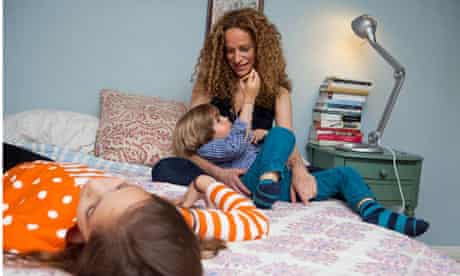
The structure of my household is messy, bohemian, warm. If there is anything that currently oppresses the children, it is the thought of the mode families are "supposed to be", an idea pushed in moving-picture show books, in classrooms, in adults' casual conversation, on children at a surprisingly early age, with surprising aggressiveness.
When I was pregnant, someone who was trying to persuade me not to have the babe said I should expect and take a "regular baby". What he meant, of course, was that I should wait and have a babe in more regular circumstances. But by this point I had seen the feet of the baby on a sonogram, and while he was pacing through my living room making this point, I was thinking: "This is a regular infant." His comment stayed with me, though. It evoked the word "bastard" – "Something that is spurious, irregular, inferior or of questionable origin."
Someone said something like to a friend of mine when she found out that she was meaning with the child of a man married to someone else. He said she should wait and have a "real baby". And someone else referred to the children her infant'southward male parent had with his married woman as his "real children". Equally if her infant were unreal, a figment of her imagination, equally if they could wish him away.
Small word choices, you might say. How could they perhaps thing to any halfway healthy person? But information technology is in these casual remarks, these throwaway comments, these adventitious bursts of honesty and flashes of discomfort that nosotros create a cultural climate; information technology is here that the judgments persist and reproduce themselves, here that one feels the resistance, the static, the pent-up, residual, pervasive conservatism to which we do non generally own up. Nathaniel Hawthorne called it "the alchemy of placidity malice, by which [nosotros] can concoct a subtle poison from ordinary trifles".
At dejeuner i twenty-four hours, I am talking to an editor about how I am thinking of writing nigh single mothers and the subtle and non-and then-subtle forms our moralism towards them takes. He says, "That'due south a good idea. And I say that as a guy who looks at unmarried women and thinks, 'What'southward wrong with her? How did she screw up?'"
One mean solar day, ane of my colleagues, noticing that I was significant with my second kid, ducked into my function and said, "Yous really do whatever you want." He meant this every bit some variety of compliment, and I took it as such, but I was start to go the sense that other people were looking at me and thinking the same matter: it seemed to some every bit if I were getting away with something, as if I were not paying the usual price, and if the usual price was takeaway Thai food and a video with your married man on a Sat night, then I was non, in fact, paying that price. James Baldwin wrote, "He tin confront in your life just what he tin face in his own." And I imagine, if you are feeling restless or thwarted in your marriage, if you accept created an orderly, warm home for your kid at a sure slight cost to your own liberty or momentum, yous might look at me, or someone else like me, and recall I am not making the usual sacrifices. (I may be making other sacrifices, just that is non part of this adding or judgment.)
I am quite prepared to believe that in a house with 2 parents, there is generally a little more than balance, a healthy divide between adult civilization and child culture, a comfortable diffusion of amore. On my son Leo'south offset altogether, his seven-yr-old sister Violet wrote him a verse form that ended with the lines, "Even if you become a wife, I'll always be the love of your life." And when her male parent left when she was a niggling nether iii, she said, "Mama, it's similar you and I are married." This would adequately accurately reflect the atmospherics of our house: a piddling as well much honey, you might tactfully say.
But I have to confess that I like the crazy intensity, the fierceness of the attachment, the too-muchness of information technology. In my heart of hearts, I don't really think "salubrious" is better. I think there are some rogue advantages to the unhealthy, unbalanced surroundings, to the other way of doing things.
Which is not to gloss over the fact that existence the only adult in a house with children can be really, really hard. There were times in the first few years of Leo's life where I wished the earth would stop spinning on its axis, so I could pace off and have a rest.
There is no dubiety that single motherhood tin be more hard than other kinds of motherhood. In France, the response to that added difficulty is to give single mothers preferential access to first-class daycare. In the UK, the response seems to be to brand alterations to the benefits, taxation rates and childcare credits that compound that difficulty; and in the US, the response is moralism disguised as concern, and sometimes just plain moralism.
At the Republican convention last yr, old presidential candidate Mitt Romney thought it would be an authentic assessment of reality to arraign the rise in fierce crime on unmarried mothers. I would exist tempted to think of this every bit a shimmering manifestation of American puritanism, only I notice it in the UK, likewise. Earlier this month, a study by the Centre for Social Justice, a rightwing thinktank, warned of a "seismic sea wave" of family breakup when it plant that more than than 1m children in the Uk are growing up without a father at home. And so there are the furious attacks in newspapers on women who have children by more than one begetter; women such every bit Ulrika Jonsson, who was nicknamed "iv x 4" a few years ago, and Kate Winslet, criticised this month for announcing her third pregnancy with a 3rd different begetter. The Telegraph berated her for "disastrous choices", request, "Has bitter experience (your offspring'southward, if not yours) taught you nothing?" And continued: "The fallout for the piffling human beings you've brought into the globe is too atrocious to contemplate." A libation listen might wonder how the writer could possibly know what goes on in Winslet's children's minds, and whether they are non, in fact, thriving, but cooler minds don't worry as much about other people's private lives.
JK Rowling, 1 of the world's virtually spectacularly productive single mothers, addressed this sort of thinking in an article for the Times in 2010: "Women like me... were, co-ordinate to pop myth, a prime number cause of social breakdown, and in it for all we could get: costless coin, land-funded accommodation, an easy life." She went on to say, "Betwixt 1993 and 1997, I did the chore of 2 parents, qualified and then worked as a secondary school teacher, wrote one and a half novels and did the planning for a further 5. For a while, I was clinically depressed. To exist told, over and once again, that I was feckless, lazy – even immoral – did not aid."
The thought of "single mothers" may itself be the convenient fiction of a fundamentally bourgeois society. In fact, like Rowling, women move in and out of singleness, married parents interruption autonomously, couples alive together without marrying, parents die, romantic attachments form and dissolve. Which is to say, the "us" and "them" tenor of the cultural conversation arises from prevailing fantasies of family unit life that bear no relation to life on the ground.
In spite of our exquisite tolerance for all kinds of lifestyles, we have a wildly outdated merely strangely pervasive idea that single motherhood is worse for children, somehow a compromise, a flawed venture, a grave psychological blow to be overcome, our enlightened modern version of shame. Information technology malingers, this thought; it affects united states nevertheless.
I have noticed that single mothers, or mothers with children from different fathers, seem to do an awful lot of apologising ("I didn't do it on purpose"; "I thought he might stay"; "I think the baby is doing OK. Obviously information technology would be better if there were a more stable family situation…"). There is a sense that you lot have to explain yourself in a manner that near no i has to any more, because even the progressive world is operating on a pretty appalling, nearly unthinking level of prejudice on this one particular result. Specifically, people would like to hear that you did non suit your life in this chaotic manner on purpose, and that you are not enjoying yourself too much, and that yous realise your way of doing things is far inferior to the conventional way and possibly blazingly destructive to your children.
In America, a recent Pew poll on attitudes toward family structure showed that there is college tolerance for gay couples raising children than there is for unmarried mothers, with about vii in 10 Americans calling single motherhood a "bad thing for society". This in spite of the fact that two of the most pop presidents in recent retention, Obama and Clinton, were the sons of single mothers. And the fact that currently in America 53% of babies born to women under the historic period of thirty are born to single mothers; which is to say that most babies born to women under 30 are "bad for society". Our ideas about these things, to say the to the lowest degree, have non caught up with the fashion nosotros are actually living.
To support the basic notion that single mothers are irresponsible and dangerous to the general society of things, people often similar to refer darkly to "studies". To me, these sorts of studies are suspect because they tend to plummet the nuance of true, lived experience and because people prevarication to themselves and others. (One of these studies, for instance, in society to measure emotional distress, asks teenagers to tape how many times in a week "you felt lonely". Is there a teenager on Earth who is a reliable narrator of her inner life? And tin anyone of any age quantify how many times in a week they accept felt lonely?)
However, studies such equally those done by the Princeton sociologist Sara McLanahan, who is 1 of the foremost government on single motherhood and its effect on children, make the case that conditions such as poverty and instability, which frequently accompany single-female parent households, increase the chances that the children involved will experience diverse troubles afterward in life. But at that place is no evidence that, without those conditions, the pure, pared-down state of single motherhood is itself harmful to children.
McLanahan's studies, and many like them, reveal that the chief risks associated with single motherhood arise from fiscal insecurity, and to a lesser extent detail romantic patterns of the mother – namely introducing lots of boyfriends into children's lives. What the studies very clearly don't show is that longing for a married father at the breakfast table injures children.
And, of course, what these often-quoted studies don't measure is what happens when there is simmering anger in the home, or unhappy or airless marriages, relationships wilting or faltering, subterranean tensions, what happens when everyone is bored.
In fact, as I learned when I talked to her, McLanahan's findings suggest that a two-parent, financially stable home with stress and conflict would be more destructive to children than a ane-parent, financially stable home without stress and conflict. In other words, our notion that "studies show" a single-parent home is categorically worse for children is wrong.
By now, I have spent then long exterior conventional family unit life that sometimes when I spend an afternoon with married friends and their children, their way of life seems exotic to me. The all-time way I can describe this is the feeling of being in a strange country where y'all detect the bread is practiced and the coffee is excellent but you are non exactly thinking of giving it all upwards and living at that place.
When my son was two, he referred to his sister's father every bit "my Harry". He would say, "My Harry is coming!" Information technology seems to me that this exuberant, unorthodox employ of pronoun gets at the conjuring, the deed of cosmos, the interesting magic trick at the centre of the whole venture: his family will exist what he makes it.
I notice people frequently observe little ways of telling me that this is not the real thing. Just is information technology necessarily worse than the existent affair? Is the concrete presence of a human being in the domicile truly as transfiguring, as magical, every bit necessary equally people seem to think? 1 could argue that a well-loved child is a well-loved kid. Many people have said to me over the years some variation of, "He needs a man in the house." Simply does he? It seems to me a picayune narrow-minded or overly literal to retrieve that love has to come from two parents under one roof, like water from hot and cold taps.
When information technology comes time for Leo's grade to study "families", I worry most how his iii-yr-old listen will process his family unit. I don't desire him to feel like an outsider in a pre-school of married, heterosexual families. Nosotros've talked nearly how there are all different kinds of families, but his world does not reflect that conversation.
When it's time to put cutout silhouettes of family members on the wall, the other children in Leo's pre-schoolhouse class put 2 parents and two, sometimes three children. Leo puts cutouts of himself, his sister, me, his father, his sister's begetter and his beloved babysitter, who has been with us since his sister was born 10 years ago. His instructor told me that when he did this, the other children started clamouring, "Wait, my babysitter is my family unit, also." "What about my grandfather? He takes intendance of me twice a week."
The wall got cluttered with rogue silhouettes, in brilliant colours, and I thought, we'll take our progress, paper cutout by paper cutout.
castillosirstion66.blogspot.com
Source: https://www.theguardian.com/lifeandstyle/2013/jun/22/two-kids-two-fathers-kate-winslet
0 Response to "When Both of Your Baby Daddies Get Along"
Post a Comment